
Why Your Business Needs a Cash-First Operating System
The retailer had clean books, shelves full of inventory, and financial statements that looked fine. The business was going broke anyway.
The statements were accurate. They answered a different question than the one keeping the owner up at night: will there be enough cash to make payroll on Friday?
That gap shows up everywhere. A service company needs 60 to 90 days of capital for every sale it makes. A manufacturer can't make enough of its best product while its margins keep shrinking. Different industries, same pattern. The reports look backward, and the owner needs to see what's coming.
Your financial statements were built for someone else
Your P&L and balance sheet are generally prepared under GAAP. That's the right standard for their job, which is satisfying compliance, lenders, and tax requirements.
They were never designed to tell you whether payroll clears this Friday.
So the reports and the bank account can tell 2 different stories. A company can show a profit while cash b...
Why AI Will Never Replace You as a Cash Flow Advisor

By David Safeer | Cash is Clear®
Every week another AI tool shows up promising to revolutionize financial services. An algorithm that predicts cash flow. A machine learning model that optimizes working capital. A chatbot your clients can talk to instead of you. Here is what nobody is talking about: none of it replaces what you actually do.
When a business owner sits across from you with a cash flow problem, they are not in crisis mode because they are missing a report. They already have reports. What they are looking for is a human being who understands the reality behind the numbers, and what is actually happening inside their business.
An algorithm can tell you that days sales outstanding jumped from 35 to 52. That is what algorithms do well. What AI cannot tell you is that the jump happened because the owner's best salesperson is letting customers slide on payment terms to hit a sales quota, and the relationship with those customers is quietly falling apart. That takes digging. T...
Your Books Say Everything's Fine. Your Bank Account Disagrees.
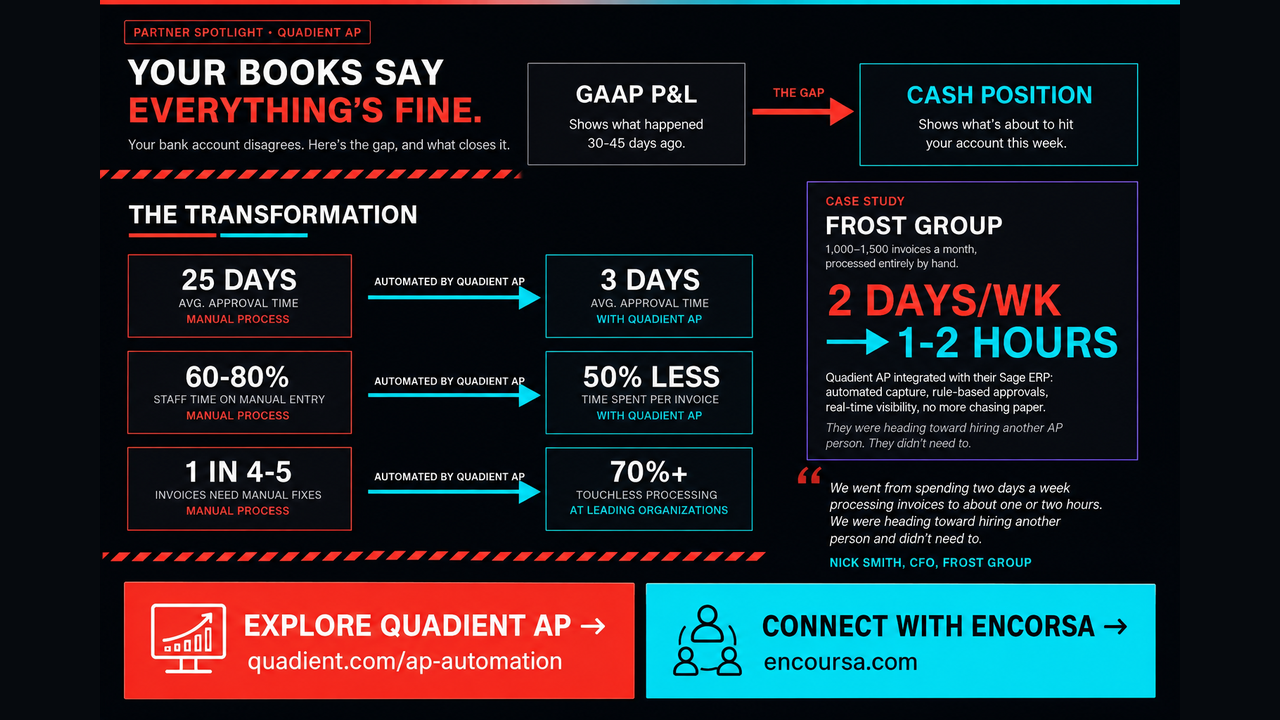
Frost Group had clean books. They still couldn't tell you what they owed until someone went and looked for it.
I see this all the time with my new clients. Accounts payable is running on email approvals, spreadsheets, and someone chasing down invoices. They get clean bookkeeping reports every month, but they can't see the day-to-day details.
The GAAP reports say, "This is what happened last month."
It's what already happened.
Accounting reports were never meant to tell you what's about to hit your bank account.
The gap between your books and your bank
This is exactly the gap Quadient AP closes.
Not another dashboard. It standardizes intake, kills manual invoice matching, and structures approvals so you're working from your real cash position, not last month's one.
Here's what the numbers show on manual AP:
- Manual AP eats 60–80% of AP staff time.
- 1 in 4 or 5 invoices needs manual intervention to fix an error.
- Getting a single invoice approved can take 25 days.
And here's...
The Multiplier Effect: How Short-Term Cash Flow Tactics Destroy Your Margins

When a company is short on cash, the instinct is to do whatever it takes to get money in the door. That instinct is understandable. It is also dangerous. Because most of the tactics that generate cash quickly carry hidden costs, and when you stack two or three of them together, the compounding effect can be devastating. What looks like a lifeline on Monday can quietly gut your profitability by Friday.
This is the multiplier effect, and it is one of the most overlooked risks in cash flow management. Financial professionals who advise struggling businesses need to understand it, because the advice that feels most helpful in the short term is often the advice that does the most long-term damage.
The Tactics That Sound Reasonable
Open any article on improving cash flow and you will find a familiar set of recommendations. Accept credit cards. Offer early payment discounts to collect receivables faster. Lower your prices to increase volume. Each of these tactics, taken individually, se...
Flip the Playbook: Why Healthy Companies Do the Opposite of Common Cash Flow Advice

By David Safeer | Cash is Clear®
There is a set of cash flow strategies that every financial professional has heard a hundred times. Collect receivables as fast as possible. Pay your bills as late as you can. Sell more. Get a loan if you need to. This is the standard playbook, and for companies that are struggling to keep cash in the bank, it makes sense as a starting point.
But here is what nobody tells you: once a company gets healthy, the best cash flow strategies are the exact opposite of that playbook. Pay early. Let customers pay slowly. Stop chasing every sale. The reversal is not a contradiction. It is a recognition that struggling companies and healthy companies have fundamentally different needs, and the strategies that keep a struggling company alive are not the strategies that make a healthy company thrive.
The Standard Playbook and Its Limits
The conventional advice is built around one assumption: the company does not have enough cash. When that is true, the priorit...
Why Financial Analysis Fails: The Human Problem Behind Business Numbers

If you have been in this work for any length of time, you have probably experienced this cycle: a client has a cash flow problem, you run the analysis, you present the numbers, and nothing changes. So you build more detailed financial analysis reports, create a KPI dashboard, and add aging breakdowns. Still nothing.
Here is the hard truth: the problem was never a lack of analysis. Your clients do not have a spreadsheet problem. They have a people problem. And you cannot solve that with another ratio.
Analysis Tells You What, Not Why
When you analyze financial numbers through financial analysis, you are looking at outcomes: the results of decisions already made yesterday, last week, or a year ago. Financial analysis tells you what is happening. It cannot tell you why.
Consider accounts receivable aging climbing from 45 days to 78 days. You can see that easily in any standard report. But the report cannot tell you why. Was it a sales rep who extended terms without telling anyone? A n...
Three Levels of Cash Flow Advisory: Why Most Advisors Get Stuck at Level One

If you're a fractional CFO, CPA, financial planner, or business coach, you already know that your clients come to you when things feel out of control. Cash is tight, the P&L doesn't tell the whole story, and the business owner is oscillating between relief and panic from week to week.
Here's the uncomfortable truth: most financial advisors are stuck at level one of cash flow advisory, and they don't even know there are two more levels above it. Each level adds more value dramatically to your clients and, frankly, makes you dramatically harder to replace.
Let me walk you through all three.
Before We Begin: The Preliminary Step Nobody Talks About
There's actually a step that comes before cash flow advisory work begins, and it's what most accountants and bookkeepers spend the most time on: reporting. Bookkeeping, financial statements, and tax preparation. It's essential work, and doing it well matters. But it looks backward, not forward. It tells you where a company has been, not wher...
Why Cash Flow Problems Are Universal (And Why That's Your Advisory Opportunity)

"Cash flow doesn't care about your religion, your race, your gender, your nationality, the language you speak, what time you wake up in the morning, what time you go to bed at night. Cash flow is a universal problem."
The Most Democratic Challenge in Business
I've worked with about forty companies in person—from Fortune 100 boardrooms in New York to small family businesses in Latin America, from startups in Asia to established firms in Europe. I've lost count of how many companies I've worked with virtually across nearly every continent (still working on Antarctica).
Here's what I've learned: Cash flow is the most democratic language and challenge in business.
Same Problems, Different Continents
Whether you're looking at businesses generating $250,000 or $20 million in revenue, the cash flow problems are identical:
A manufacturing company in São Paulo can't meet payroll because customers stretched their payables from 30 days to 60 days without asking permission.
A professiona...
Finding Opportunity in Chaos: A Business Philosophy for Uncertain Times

If I could share one message with the business world—important enough to place on a billboard for everyone to see—it would be these five simple words: "Out of chaos comes opportunity."
This philosophy was shared with me by a vice president I worked for over 30 years ago, and it has become a mantra that guides my approach to business and life. The message resonates particularly strongly in today's volatile business environment, where change is constant and disruption is the norm.
Embracing Rather Than Fearing Change
Most of us instinctively fear change because we know it brings a period of chaos. Whether it's implementing new financial systems, pivoting your business model, or adapting to market disruptions, the transition period is uncomfortable at best and terrifying at worst.
I've seen this fear paralyze otherwise capable business owners, keeping them trapped in dysfunctional systems that slowly drain their resources and enthusiasm. The business owner who continues to overstock i...
From Compliance to Advisory: The Transformation Your Clients Are Waiting For

There's a clarity gap in the financial services industry. On one side, we have professionals skilled at recording what happened. On the other side, we have advisors who help clients understand what to do next. The technical knowledge is the same. What's different is the ability to translate past numbers into future cash decisions.
This gap represents the biggest opportunity in financial advisory today. Companies don't just need someone to tell them their accounts receivable increased. They need someone who can translate that increase into actionable intelligence: what it means for their cash position next week, what options they have to address it, and what the financial impact of each option will be over time.
Why Technical Skills Aren't Enough
We spend years developing technical expertise. We learn GAAP accounting, we master QuickBooks, we understand how to properly categorize expenses and reconcile accounts. These skills are essential, but they're just the foundation. They're wha...
